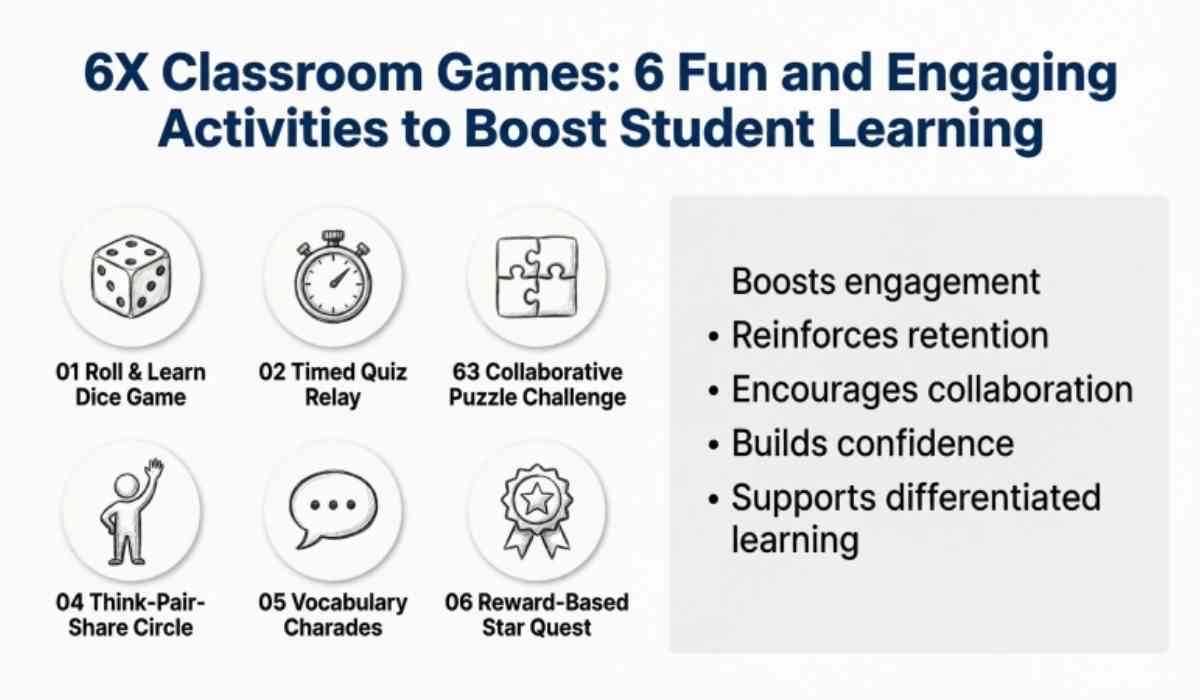
Making learning fun isn’t just a nice idea. It actually works. When students are laughing, competing, and collaborating, they absorb information faster. 6X Classroom Games turn passive sitting into active participation, and that shift changes everything about how students feel in your room.
Teachers who use fun 6X Classroom Games activities regularly see better focus, stronger recall, and fewer behavior problems. You don’t need fancy tools or extra budget. You just need a few solid game ideas and a willingness to try them. The six activities below are simple, proven, and genuinely enjoyable.
Best Classroom Games for Students
Educational games for students work because they lower the pressure of being wrong. When it feels like a game, students take more risks, ask more questions, and stay engaged longer. That’s the real magic here.
Interactive classroom games also build confidence. Students who rarely raise their hands often shine during games. These six picks cover review, teamwork, vocabulary, and creative thinking, so there’s something useful for every teacher and every subject.
| Game | Best For | Prep Time |
|---|---|---|
| Human Bingo | Icebreaking | 5 mins |
| Jeopardy | Exam review | 15 mins |
| Pictionary | Visual learning | 5 mins |
| Role Play | Comprehension | 10 mins |
| Flashcard Showdown | Vocabulary | 0 mins |
| Mystery Word Relay | Quick recall | 5 mins |
Read More: How Old Is Fanum? Full Biography, Personal Life Facts
Fun and Engaging Classroom Activities
Great engaging classroom games don’t need complex rules. Simple formats with a bit of competition or surprise keep energy high from start to finish. Students remember how a lesson felt, and games make it feel worth remembering.
Student engagement activities rooted in play also reduce test anxiety. When students practice content in a low-stakes setting, they show up to exams with more confidence. The six games here are easy to run and work across grade levels.
- No expensive materials needed
- Work for grades 3 through 12
- Can be adapted for any subject
- Take 10 to 30 minutes each
- Encourage cooperative learning activities
Interactive Learning Games for School
Active learning games get students out of their heads and into the lesson. Movement, discussion, and friendly competition all trigger better memory and deeper understanding than reading alone ever could.
Learning games for school also teach soft skills without anyone noticing. Students practice communication skills, patience, and quick thinking while they play. That’s a lot of value packed into a single class period.
| Skill Developed | Game That Builds It |
|---|---|
| Critical thinking | Jeopardy |
| Creativity | Pictionary |
| Communication | Role Play |
| Teamwork | Human Bingo |
| Memory | Flashcard Showdown |
| Vocabulary | Mystery Word Relay |
- Problem solving classroom activities boost confidence
- Games improve classroom participation
- Students learn from peers, not just teachers
- Visual learning games help diverse learners
- Easy to modify for any difficulty level
Classroom Review Games for Exam Prep
Classroom review games are one of the best tools before a big test. Instead of re-reading notes, students quiz each other, recall facts under pressure, and fill in gaps they didn’t know existed.
Exam review games for students also create a natural feedback loop. When a team answers wrong, the class discusses it immediately. That on-the-spot correction sticks much better than corrections written in red on a graded paper.
| Review Method | Retention Rate | Student Energy |
|---|---|---|
| Re-reading notes | Low | Low |
| Flashcard solo study | Medium | Low |
| Jeopardy game | High | High |
| Rapid-fire quiz | High | High |
| Mystery Word Relay | Medium-High | High |
- Use quick recall classroom activities 2 days before tests
- Rotate teams to keep it fair
- Mix easy and hard questions
- Fun ways to review lessons stick longer than passive study
- Award small prizes to keep motivation up
Team Building Games for the Classroom
Team building classroom games do more than review content. They teach students how to listen, share ideas, and work toward a shared goal. Those skills matter just as much as the lesson material itself.
Classroom collaboration activities also shift the social dynamic. Quiet students find their voice. Dominant ones learn to share space. Over time, games that require cooperative learning make the whole class function better, not just during game time.
- Mix groups intentionally, don’t let students always self-select
- Rotate roles so everyone leads at some point
- Debrief after games to reinforce teamwork lessons
- Group games for students reduce clique behavior
- Interactive group activities for school build trust fast
Human Bingo Icebreaker Activity
Human Bingo is a classic icebreaker game for classroom use because it gets everyone moving and talking within minutes. Each student gets a bingo card filled with traits or facts, then finds classmates who match each square.
It’s perfect for the first week of school or after a long break. Students practice communication skills naturally while learning something real about their peers. It’s one of those easy classroom games with no prep once your cards are made.
How to run it:
- Create bingo cards with prompts like “has a pet” or “speaks two languages”
- Students walk around and find one person per square
- First to complete a row wins
- Works great as a bingo icebreaker activity
- Builds classroom participation from day one
Jeopardy Style Classroom Review
Jeopardy classroom game format is probably the most popular classroom review game for a reason. Students pick categories and point values, answer questions, and compete in teams. The stakes feel real even though nothing serious is on the line.
A Jeopardy style quiz for students works for almost every subject, from math facts to literary terms to science vocabulary. Build your board in Google Slides or on the whiteboard. Either way, it runs smoothly and students always want to play again.
Quick setup tips:
- Use 5 categories with 5 questions each
- Assign point values from 100 to 500
- Let teams discuss before answering
- Add a Daily Double for surprise moments
- Great for classroom games for test preparation
Pictionary for Subject Learning
Pictionary classroom game swaps words for drawings and suddenly students who struggle with writing get to shine. One student draws a concept while teammates guess. It’s fast, loud, and surprisingly effective for vocabulary retention.
Subject-based Pictionary works well for science diagrams, historical events, literary themes, and math concepts. It’s a pure visual learning game that forces students to think about meaning deeply enough to represent it without words.
Ways to use it:
- Draw vocabulary words for word units
- Illustrate scenes from a novel or history event
- Sketch science processes like photosynthesis
- Use for creative learning activities across subjects
- Helps students with vocabulary building through images
Role Play Activities in Teaching
Role play classroom activity puts students inside the content. They become the historical figure, the character from the novel, or the scientist defending a theory. That level of engagement makes the lesson genuinely memorable.
Role play scenarios for students also build empathy and perspective-taking. When a student has to argue a position they didn’t hold before, they understand the material from a completely different angle. That’s critical thinking happening in real time.
Simple role play ideas:
- Historical debates (Lincoln vs. Douglas format)
- Customer and business owner for economics lessons
- Scientist press conference to explain discoveries
- Character interviews after reading a novel
- Great for problem solving classroom activities
Flashcard Showdown Competition Game
Flashcard showdown turns solo studying into a head-to-head educational competition game. Two students face off, the teacher (or a third student) holds up a card, and the first to answer correctly wins the round. Fast, simple, and surprisingly tense.
This flashcard classroom game works at every grade level and for any subject with clear factual recall. It’s also one of the best easy classroom games with no prep since students can use cards they already made during study time.
How to run it well:
- Bracket-style tournament keeps everyone watching
- Losing students become judges or card holders
- Mix in vocabulary review activities and math facts
- Works great as a rapid-fire quiz game
- Keeps energy up even during the last class of the day
| Round | Format | Time Needed |
|---|---|---|
| Warm-up | Pair practice | 3 mins |
| Round 1 | 1v1 matchups | 5 mins |
| Semifinals | Best of 3 | 5 mins |
| Final | Full class watch | 5 mins |
Conclusion
Classroom games aren’t a reward for finishing real work. They are real work. When students compete, collaborate, and create, they’re processing content in ways that plain lectures can’t match. These six activities give you a solid starting point for how to make classroom learning fun without overcomplicating your planning.
Pick one game this week and try it. Watch how your students respond. You’ll likely notice more energy, better participation, and stronger recall. Games that improve critical thinking and classroom games for skill development are tools every teacher deserves in their routine. Start small and build from there.