

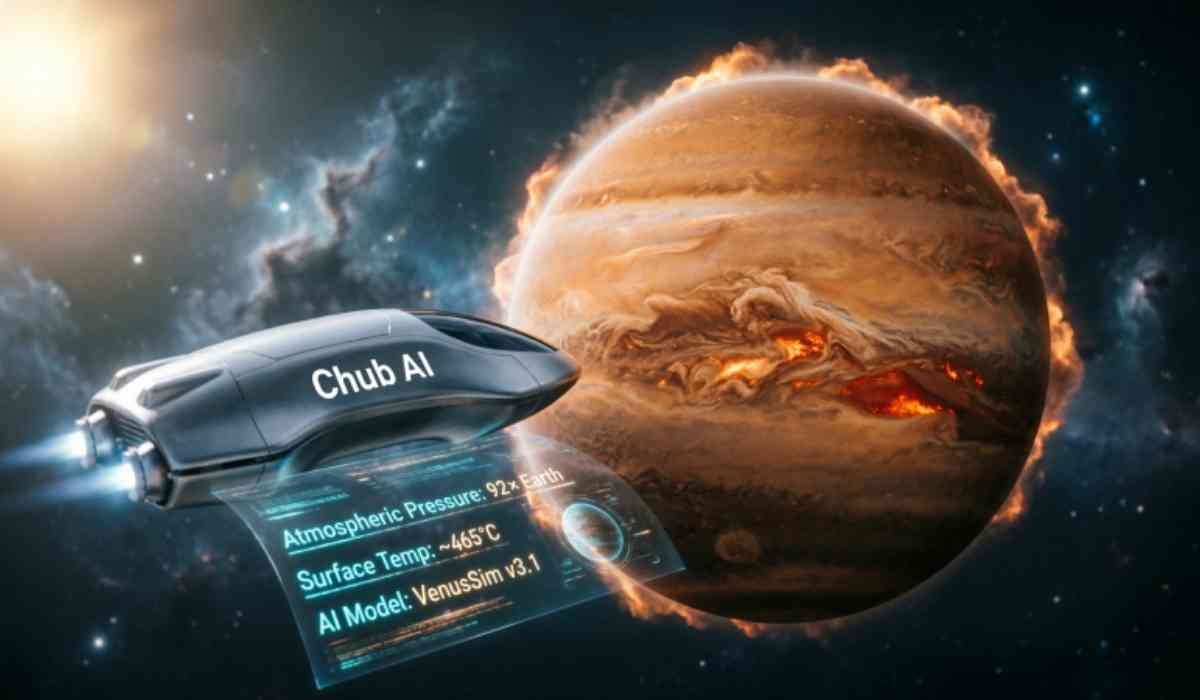
Chub AI Venus has always been one of the most mysterious planets in our solar system. Scientists have studied it for decades, but the extreme conditions make direct exploration nearly impossible. That’s where technology steps in and changes everything about how we understand this fiery world.
Today, tools like Chub AI Venus are helping researchers model and simulate planetary environments from Earth. AI in Venus exploration is no longer just a concept. It’s an active field producing real insights, real data, and real progress in understanding one of our closest and most dangerous neighbors.
What Is Chub AI Venus
Chub AI Venus is an AI powered simulation platform designed to model planetary conditions, focusing on extreme environments like Venus. It processes real time planetary data analysis to give researchers a working digital version of the planet without ever leaving Earth.
Think of it as a virtual lab. Scientists feed in atmospheric data, surface readings, and geological information. The system then builds a living model that behaves like the actual planet, helping teams run tests and experiments safely.
Key features of Chub AI Venus:
- Models Venus surface conditions using real mission data
- Supports geological modeling of Venus in high detail
- Runs Venus atmospheric simulation continuously
- Integrates with scientific simulation software tools
- Helps identify landing site identification Venus targets
Read More: How Old Is Fanum? Full Biography, Personal Life Facts
How AI Simulates the Surface of Venus
AI planetary modeling works by taking raw data from past missions and running it through machine learning algorithms. The result is a detailed, constantly updated picture of what the surface looks like and how it behaves.
Venus surface simulation involves pressure readings, heat mapping, and chemical analysis all running together. The AI stitches these into one coherent model that researchers can interact with and test theories against.
What the simulation includes:
- Surface temperature and thermal patterns
- Volcanic activity simulation zones
- Terrain mapping using radar data
- Geological data visualization layers
- Real time updates from orbital probes
| Simulation Layer | Data Source | Update Frequency |
|---|---|---|
| Surface Terrain | Magellan Radar | Monthly |
| Atmospheric Pressure | Venus Express | Weekly |
| Temperature Mapping | Akatsuki Probe | Daily |
| Volcanic Activity | Seismic Models | Real Time |
Venus Surface Temperature and Pressure
The temperature on Venus sits around 900 degrees Fahrenheit, hot enough to melt lead. That’s not just hot. It’s consistently hot, day and night, across the entire planet.
The atmospheric pressure on Venus is about 90 times that of Earth at sea level. Combined with the heat, these extreme conditions on Venus make surface exploration one of the hardest engineering challenges humans have ever faced.
Quick facts:
- Surface temp: roughly 900 degrees Fahrenheit Venus
- Pressure: equivalent to being 900 meters underwater
- CO2 makes up over 96% of the atmosphere
- Venus hostile environment destroys most materials within hours
- Clouds are made of sulfuric acid droplets
| Condition | Venus | Earth |
|---|---|---|
| Surface Temp | 465°C (870°F) | 15°C (59°F) |
| Atmospheric Pressure | 92 bar | 1 bar |
| Atmosphere Composition | 96% CO2 | 78% Nitrogen |
| Wind Speed (upper clouds) | 360 km/h | 50 km/h avg |
AI in Planetary Science Research
Artificial intelligence in planetary science has grown from a niche tool into a core research method. Scientists use it to handle data volumes that no human team could process manually, turning raw numbers into useful knowledge.
AI driven space research now covers everything from crater analysis to cloud tracking. It speeds up discovery, reduces errors, and lets researchers focus on interpretation rather than data crunching.
How AI helps researchers:
- Processes terabytes of sensor data automatically
- Flags anomalies in Venus research technology readings
- Runs simulations faster than traditional computing
- Supports advanced algorithms for space research
- Assists in planetary evolution modeling
Predicting Venus Weather Patterns With AI
Venus weather prediction AI focuses on the upper cloud layers where winds reach extreme speeds. These clouds move faster than anything on Earth, and tracking them requires serious computing power.
Planetary weather systems modeling on Venus is tricky because the planet has no seasons and very slow rotation. AI handles this by building pattern libraries from years of observational data and using them to predict future cloud behavior.
What AI tracks in Venus weather:
- Cloud formation analysis Venus in real time
- Upper atmosphere wind patterns
- Sulfuric acid cloud density shifts
- Temperature gradients between layers
- Atmospheric modeling AI for storm prediction
| Weather Feature | Speed/Scale | AI Tool Used |
|---|---|---|
| Upper Cloud Winds | 360 km/h | Pattern Recognition |
| Polar Vortex | 2,500 km wide | Neural Networks |
| Cloud Layer Thickness | 20 km deep | Data Classification |
| Zonal Wind Cycles | 4-day rotation | Time Series Analysis |
Geological Features of Venus Explained
Venus is covered in volcanoes, highlands, and vast lava plains. Geological modeling of Venus reveals a surface shaped almost entirely by volcanic activity with very few impact craters compared to other rocky planets.
Volcanic activity simulation tools have helped scientists identify features that might still be active today. Recent AI analysis of radar images found changes in volcanic regions that suggest eruptions may have happened within the last few decades.
Major geological features:
- Maxwell Montes, the highest mountain range
- Ishtar Terra and Aphrodite Terra highlands
- Over 1,600 major volcanoes identified
- Coronae, unique circular volcanic structures
- Tesserae terrain, ancient deformed crust
Challenges of Landing on Venus
Challenges of landing on Venus start before a spacecraft even touches the surface. The thick atmosphere creates intense friction during entry, and the heat builds fast. Most probes have survived only about an hour before failing.
Spacecraft survival on Venus depends on materials that can resist crushing pressure Venus and extreme heat simultaneously. Current technology isn’t quite there yet, though new heat resistant materials and Venus probe technology are showing real promise.
Main landing challenges:
- Entry heating during atmospheric descent
- Crushing pressure Venus destroying probe casings
- Sulfuric acid cloud corrosion during descent
- Short operational window once landed
- Communication delays with Earth based teams
| Challenge | Current Limit | Possible Solution |
|---|---|---|
| Heat Resistance | 1 hour survival | High temp alloys |
| Pressure | 92 bar crushing | Titanium shells |
| Acid Corrosion | Surface damage | Ceramic coatings |
| Power Supply | Battery drain | RTG systems |
Future Missions to Venus
Future missions to Venus are picking up momentum. NASA’s DAVINCI and VERITAS missions are in development, and ESA’s EnVision mission is also moving forward. All three will use modern AI powered space missions technology.
Venus mission planning now leans heavily on autonomous space research systems to make decisions faster than human controllers can manage across the communication gap. AI will help these probes navigate, prioritize data collection, and respond to unexpected findings.
Upcoming mission highlights:
- NASA DAVINCI: atmospheric probe dropping through clouds
- NASA VERITAS: global surface mapping mission
- ESA EnVision: radar and spectrometry focused
- Next generation space exploration tools on board
- AI space robotics for autonomous decision making
Can Venus Support Life
Life on Venus seems impossible on the surface, but the clouds tell a different story. At around 50 kilometers altitude, temperatures and pressures are actually Earth-like, which has sparked serious scientific interest.
Could Venus support life in those cloud layers? Some scientists point to unexplained chemistry as potential biosignatures on Venus. AI driven astrobiology research is now scanning atmospheric data from past missions looking for patterns that biology might explain.
Key areas of interest:
- Venus cloud chemistry at 50 km altitude
- Phosphine detection debate and follow up studies
- Habitability of Venus in historical models
- Venus past climate research suggesting ancient oceans
- AI scanning for unusual chemical signatures
AI Powered Space Exploration Technology
AI powered space missions are changing how we explore, not just Venus but every planet we study. Onboard AI systems can process data, make decisions, and adapt in real time without waiting for instructions from Earth.
Planetary exploration technology now includes machine learning for image analysis, autonomous navigation, and environmental data processing AI. These tools are getting smarter with every mission, building a foundation for the next generation of deep space exploration.
Core AI technologies in use:
- Machine learning for terrain and geological data visualization
- Autonomous hazard detection systems
- Real time data analysis in space tools
- Neural networks for atmospheric pattern recognition
- Predictive modeling for space missions planning
Conclusion
Venus remains one of the most challenging targets in planetary science, but tools like Chub AI Venus are closing the gap between curiosity and knowledge. AI is letting us explore virtually what we can’t yet reach physically, and the results are genuinely exciting for the entire scientific community.
As future missions to Venus move closer to launch, the role of AI planetary simulations will only grow. From weather prediction to landing site identification Venus, AI is helping us prepare smarter, explore safer, and understand deeper. The planet next door is finally giving up its secrets.
